Showing posts with label board games. Show all posts

Sunday, September 8, 2013

Long-Runtime Board Game Night Trial Run

Introduction

Last night was a trial run for "Long Runtime Board Game Night", which was an attempt to let some longer-explanation games out on the table. The games of the evening were (in order) Castle Ravenloft, Dungeon Roll, and Last Night on Earth. It seemed to be a good evening overall, as all of us got the chance to learn at least one new game by the end of the night. This will briefly mention each of the games of the night, in reverse order to how they were played.

Last Night on Earth

Becky and Father Joseph hanging out while Jake fights off a zombie.
The new one was for me was Last Night on Earth (the last game of the evening). I'd seen it on TableTop a while back, and was pretty neutral to the game, but figured the 90 minute playtime was worth a shot (it was around 11pm at this point - the game still took us over 2 hours to play though).
I played Becky, the Nurse that couldn't heal herself worth a damn.
This was a 6-player game and I played the hero Becky (the Nurse, who awkwardly can heal other heroes but not herself). Other hero players were Johnny (Highschool Quarterback), Jake Cartwright (The Drifter), and Father Joseph (Man of the Cloth).

Generally, when I watched TableTop I was pretty meh about this game, and that opinion persisted when playing it in real life; while I liked the strong theme of this game, the gameplay never really did it for me. Oddly, the game felt really imbalanced, with a heavy skew toward the zombies initially, but a heavy skew toward the heroes later on. When playing, we did note a combo of Nurse Becky with Father Jospeh allowing for Zombie/opponent card cancellations every turn that was pretty neat. Personally I thought "Johnny Highschool"'s gameplay was more entertaining though (his ability to win ties against zombies, in addition to his character's ability to role really well overall).


After playing the game, I have a better opinion of the game than I did on TableTop, but it's still not as much a game I'd jump at the chance to play. Thinking of it as a derivative of Risk I think the card/weapon elements of the game gave it a better fell than the original Risk game, but it's still pretty random. If you like theme in your games I definitely think this is a great game to introduce to non-gamers, because the characters and theme really carry this game. There's a definite lopsided feel to the game, but it seems to balance somewhat as gameplay continues. But it is a fun game for people that like that B-movie ambiances, and I would recommend it if you like that in your games.

Dungeon Roll

This was a game I picked up thanks initially to the eleventh-hour contribution of Tim Baldwin, a Kickstarter backer that bought a bunch of Dungeon Roll last-minute in order to reach its last stretch goal. I wasn't a backer of the original Kickstarter, but learning Tim's story I got one of his copies via email/PayPal communication. Although the intention of the evening was for a few longer games, I packed a couple short and simple games as well as a backup (other games that weren't played that evening included Ultimate Werewolf: InquisitionThe Little Prince and Bohnanza).
Kickstarter box for Dungeon Roll [instagram]
We played this as a 3-player game, going through the rule details more as we progressed (if you're curious about the game, here's a good video of the rules/gameplay). Although it's discussed as being a 1-4 player game, I've noticed its more interactive in the 1-2 player range, although for learning/social purposes it can support higher numbers ok. I've found this to be a good quick game if there's about 15-30 minutes of down time and you're ok with the game's randomness.

Castle Ravenloft

Castle Ravenloft, the first game of the night.
I've played this game several times now, and if you have nostalgia for the days of HeroQuest I'd recommend this game highly. This is a game brought to you by Wizards of the Coast (WotC) as a set of board games to mirror D&D campaigns (to try and appeal to the non-RPGing camp, and I think it does a really good job). In addition to this game, WotC made board games called the Wrath of Ashardalon, and the Legend of Drizzt, which all have similar mechanics.
"Hey guys!" (Wraith appearing in a game of Castle Ravenloft)
This is a cooperative game, similar to board games like Pandemic but can be a bit more involved. Whereas HeroQuest has one person as the Dungeon Master, this game allows for everyone to play game, so random elements instead lead to game progression. If you like the D&D world, WotC represents it well in this game; while it's not my favorite cooperative game ever, it's pretty high up there, and one I always enjoy playing.

As a notable side comment, you may want to consider coloring the hero miniatures or replacing them in time, as it can get difficult to identify them by their poses alone. It's not a huge issue, but a notable one (part of me still wishes for different color figures like in Ghost Stories)

Conclusion

My hope behind this game night was that people could get introduced to some of the more complex and involved games, with an acknowledgement that digesting the rules may take a bit. In some respects I think that succeeded, because Castle Ravenloft and Last Night on Earth does take a bit of time to get introduced to (as a group we're still screwing up on the rules of Ravenloft, though at this point we're mostly right). In other ways though maybe we should've gone with the game a majority of us didn't understand first, because when 1am rolls around, the less you have to think the better.

Although I would've liked to play one of the longer games out there (Last Night on Earth had the longest playtime as listed on boardgamegeek.com at 90 minutes), I'm certainly not disappointed to have played the games that came out instead. At the end of the day, what I enjoy most about board games is less what's played, and instead the social and entertainment aspects associated with the games.

Monday, August 26, 2013

Dominion in a Smaller Form Factor

Introduction

It's time for another one of Tom's crazy arts and crafts projects. This takes another look at Dominion, a game I've tried to work out my own storage solutions for, as addressed in previous posts.

This time though I want a different discussion about Dominion. Over time I've noticed it's harder to get people interested in playing this game. There are many reasons for this:

For one, the game looks pretty boring, and overall consensus is that this game is pretty much theme-less. The bland conventional style doesn't really hold up against other games on a shelf at a Barnes & Noble. I fully admit it took me years to buy Dominion (which came out around 2009), and a big part of it was that it was the incredibly uninteresting box. Dramatic games, like King of Tokyo or Smash Up are much easier sell, for instance.
Would you like Giant Monsters Battling, Dinosaurs with Lasers,
or Rolling Fields of Quiet Tranquility?
The second reason was that I heard it compared as a step above Collectible Card Games, or CCGs (the most famous example being Magic: The Gathering). In fact, the game's designer Donald X. Vaccarino expressed that his appreciation for Magic influenced him for this game. As an off-again-on-again Magic player over the years, I avoided the game somewhat because of that comparison, because "inspired by a CCG" doesn't seem like a good selling point to me. The "money pit" aspect of Magic is a pretty large deterrent for me.

When I went on vacation to the Pacific Northwest this year, I stumbled on a different game that I really enjoyed called Nefarious, that I discovered was also by Vaccarino. Also, a friend of mine raved about Dominion while I was out there, so I chose to bite the bullet and try it out.

The third reason Dominion is a hard sell is because it's kinda unwieldy. If you stuffed them into a 250-card paper box you'd probably do ok, but then you'd have what looks like a card game in a paper box. See reason #1 again - presentation really helps. When I've carried my storage solutions for Dominion around I've felt eyes on me with the same flat stare of the guy selling "real Rolexes" on the street corner with his overcoat.

I've really been relying on these posts to be a partial selling point for Dominion, because unless I start making Dominion X-TREME (The Smithy picture [tentatively!] will have Thor and a Laser Anvil for instance), this game will only really spread by word of mouth.

The third point is what leads me to the main part of this post. I want people to get interested in this game, but I can't lug around huge boxes of cards with me all the time. So what can I do about this?

A Matter of Scale

One of the things that dawned on me when I started thinking about this problem is that Dominion cards were - somewhat unnecessarily - the size of playing cards. Though these cards get filled with card descriptions and artwork, you really don't need any of it outside of the name. So my first thought was to split the size of the cards in half. Conceptually this would also help with carrying all these cards around since it would halve everything, including size and weight.

Permanent marker on a blank Bicycle playing card can get a lot
of detail - more than enough for half a card.
I've gotten packs of blank faced Bicycle cards through Amazon on occasion (recently I purchased some blank decks to make a personal version of Hanabi since I couldn't find the game through retail outlets), so testing this scaling adjustment seemed to be pretty easy. I split some extra cards in half to see how they'd be. (I recommend a paper cutter for doing this instead of scissors - your hands will thank you)

Since each blank set was 56 cards, splitting the cards in half made it 112 (with no room for error). The base set of Dominion supports 2-4 players, and minimally requires 254 (3x8 minimum victory cards, 10x10 supply cards, and 60+40+30 treasure cards), so I had to reduce the set to 224 to keep the cards manageable and not hack up a third set of cards. I worked around this by restricting this solution to 2 players and then removing 10 of each treasure card type, since if you're going through any of those supplies in a 2-player game you're doing it wrong.

The Progression of building Victory Points
All cards were they drawn using permanent marker, and I think they look pretty ok. I didn't want to be intricate with drawing these cards for a few reasons:

  1. This is only meant to be a portable learning set, not a replacement for the game.
  2. There was no room for error; I didn't want to waste any cards.
  3. Tediousness; even only for two players I was still applying permanent marker to 224 cards.
  4. I already own the cards, so why would I want to make a pretty set when I could use what I own?

In the end I got through drawing everything over 2 nights, and several hours per night. I don't recommend doing this unless you're a patient person with stuff like this.


Conclusion

You can see the end product in a little Instagram video here: http://instagram.com/p/dTa9zbpZFw/. It'll fit in two back jean pockets easily and play for 2 players without being unreasonably tiny. Cost would minimally be about $10 if you have the markers already, and probably about 8 hours of patience.
"Dominion Pocket" : Includes the Base Set Recommended
Starting Supply and resources for a 2-Player game. No rules,
but that's why there's the Internet. [Instagram]
One of the main reasons I give myself these little projects is that it helps me think about the products I purchase, and their construction. I think it's similar to carpenters eyeing IKEA furniture as a baseline for their own personal projects, and maybe I'd do that to if I had the tools and the space (one of the downsides to apartment life, though if TechShop was closer than Pittsburgh these posts would be about tables instead of table games).

In any case, this was a little different from previous Dominion posts, more in line with my posts about reconstructing games than storing them. Hope it was at least a little interesting to you. If not, I'm sure we can all look forward to Dominion X-TREME in the near future.

Sunday, July 28, 2013

Midnight Party 1/3 : Oh Look, An Art Project.

Introduction

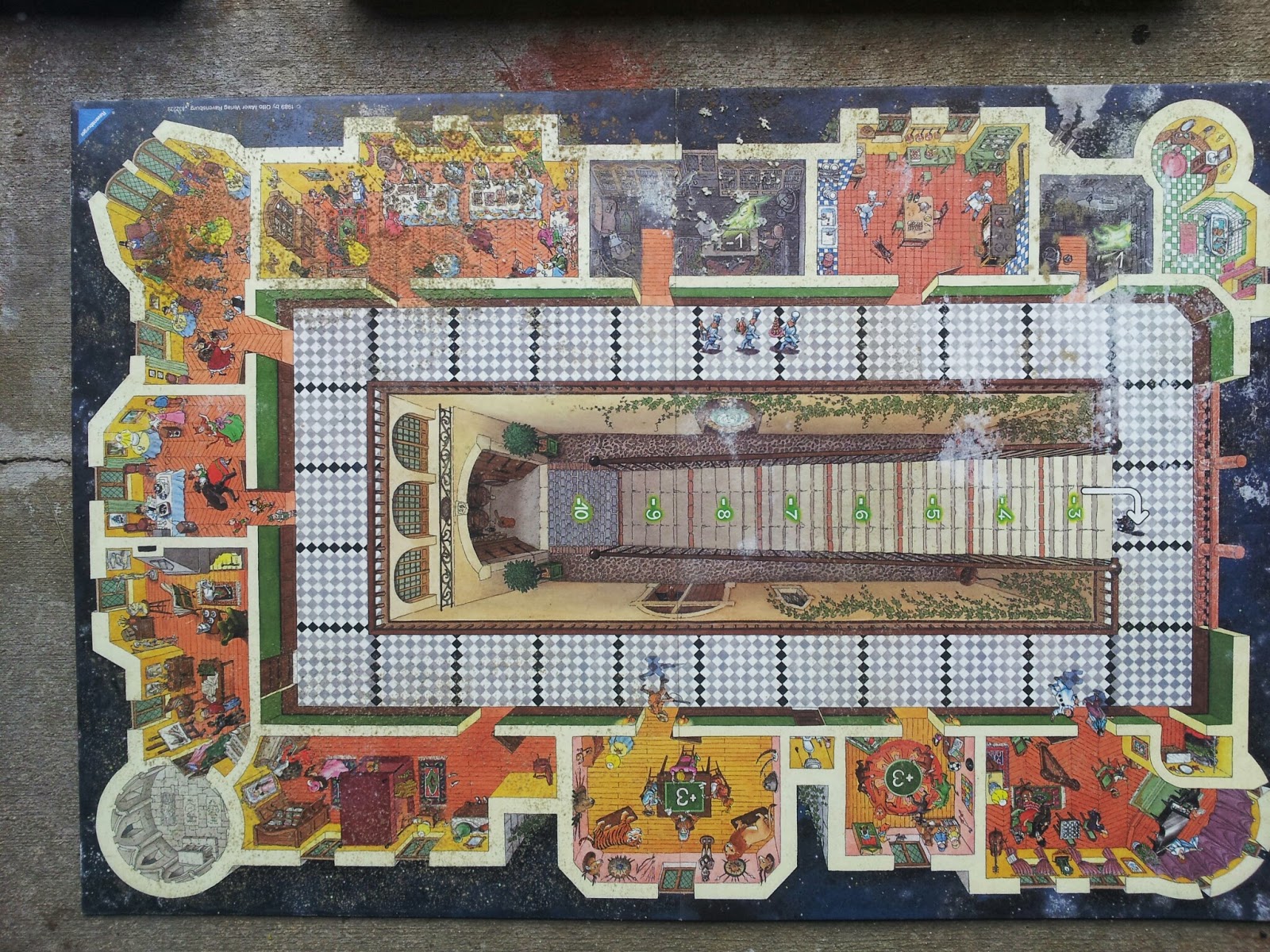
So I've mentioned Midnight Party a few times now in recent posts. This game was very much a kid's game (supports ages 4 and up) from 1989. It was designed by Wolfgang Kramer, who years later would create several games of greater popularity (like El Grande, The Princes of Florence, Torres, Colosseum, Category 5, and his Mask Trilogy of games).
The box (above) and rules were destroyed by water. You can
see some of the damage on the upper part of the box.
I remembered liking Midnight Party fondly as a kid, probably because of the wonderful theme and simple rules behind the game. The ghost in the game (Hugo) has a birthday party, and all the players control guests playing hide and seek with him for 3 rounds. When Hugo comes out from the cellar everybody needs to find a room to hide in for points. Those captured by Hugo receive penalty points.
Early sketch, just playing around. [Instagram]
While I don't think this game holds up 100% over time (it's a fairly random game), I like a few aspects of it. The pieces are well made, and for its time the board projected the theme very well. Additionally, I like that it works for 2-8 players, which is a rarity in a lot of board games.

The pieces that were still good were:

  • Hugo the Ghost
  • Ghost die (d6 with 1, 2, 4, 5 and 2 Ghost faces replacing the 3 and 6)
  • 30 Guests
    • 6 Blue and Red (for a 2+ player game)
    • 5 Turquoise (for a 3+ player game)
    • 4 Yellow (for a 4+ player game)
    • 3 Black (for a 5+ player game)
    • 2 Purple, Green, White (for a 6-8 player game)

Design

The only thing I really need to rework is the game board. The problem is that I really want this to be as visually captivating of a game as I can make it. In order to do this I started taking one approach, and then started along a secondary one. Neither are finished yet, but I think enough process has been hashed out to at least start talking about these designs. I plan to complete both designs in the future.
I took general and detailed pictures of the board to
try and capture as much detail as possible.
(The upper left part was in pretty bad shape though)
Initially I wanted to make a basic paper replication of the game, so I could have a quintessential board to work off of like I did for Pipeline. Nothing really amazing with that - paper and Rapidograph pen as usual.
Game board with some measurements and added notes.
Some board/box sketches.
above: assembled, below: separated.
As I was looking at it though, I recalled how I always wished the cellar on the board was more like an actual cellar - with some depth and character built in. Given this thought, I set to work on making a box for this quartered board, so when opened, the room panels could lay across the box and the inside act as the cellar.

I sketched out some ideas on how to accomplish this kind of presentation and eventually came up with the idea on the right. Pretty much the idea is to try and have a shallow box for pieces to keep the cellar from being so steep that pieces can't stay on the tilt.

I got some wood and additional components from Home Depot and then went to Michael's for some Acrylic paint to paint the boards with. I figured since this painting part would probably take the most time, I should start looking into getting a heads start on it. I chose acrylic paint because I knew it would provide bold colors and dry quickly, but it had also been at least a decade since I cracked open acrylic paint.

Revelation

I was looking at some canvases to practice painting with acrylics on and then it hit me: For some games, I could paint the boards on canvas and store them as such. It was a fascinating idea - the board as art and the pieces stored behind the canvas. I'm sure some of the inspiration came from getting CO2 recently (the watercolor look is beautifully striking), but I think a majority of the idea game from Solarquest. Up until this point I was considering learning how to make my own [typical] game board (this still may occur), but the idea of working tirelessly on painting a board that would just get stored in a box seemed a little demoralizing.

I picked up a 10"x20" canvas and got started on another game board for Midnight Party testing this idea out (I used Midnight Party because its board is both smaller and more difficult than the Solarquest board - pretty sure I can paint planets). Here are the results after each round of painting so far:

Round 1 (Basic layout)
Round 2 (Early text and detail)

While not yet complete, I think these can kinda show how I'm thinking this could work. Furthermore I think if I can add something that would allow pieces/rules to be stored behind the canvas (without much increase in weight), this may be a really neat way to present games to people. "Hey, you want to play chess? Here, let me pull it off the wall for you."

Game pieces on canvas. See an unnecessary autoawesomed
version of this at the bottom of this, courtesy of Google+ .
In the end, I think it's a really neat idea for board games - and for art. Art for me has really escalated more and more toward pretentiousness and elitism in a way that saddens me. I personally don't think that brand of art has much higher to climb though; my two most recent New York trips had MoMA highlighting artists that were either reviewed in their own Ivory Towers, or "Gimmicky Diversions". I've come to appreciate more of the less pretentious art over the years, and I feel the more sincere pieces can hold up better in time and appreciation. In my lifetime I'd love to see an artist with the passion of Van Gogh over the extravagance of Dali for instance.

Conclusion

So initially I had one board idea and game out with two. My intention at this point is to complete the canvas version in the near future and look at a Solarquest board next (unless something else catches my eye more). On the side, I'm hoping to construct my initial box and board design, although I know there's more construction involved in this one.

Bonus: Unnecessary Autoawesome

Google+ has an effect called "Autoawesome" that gets applied to a sequence of similar pictures taken over a short timeframe. While I find them distracting to the post, it's kinda fun to see what they do. So here you go.

I guess it's a good way to see that these pieces do, in fact,
have three dimensions.
It was hypnotic enough that I felt the need to add it in.

Sunday, July 14, 2013

Rolling for Initiative (or Blogging with Inspiration)

Introduction

So I went home recently looking for an older game I was talking about at work. It was called "APBA Baseball" and although originally published in 1951, the version we had was probably from the 1970s or 1980s. To briefly summarize the game, there was a base game you bought, and then every year they released a set of all players as an annual expansion to the game. Sort of like Madden football video games, but as a board game. With you and your opponent each choosing a team set, you could play each other using the players from that team in that year, with dice incorporating a randomization factor. I don't recall playing it a whole lot, but it was an interesting concept. When fantasy football started becoming a mainstream internet attraction, this was the first thing I remembered.

Here's an amazing video about it from the New York Times five years ago:


Interestingly, this board game is still a thing, even after 70 years, and it covers most major sports including Football, Soccer, Hockey, Basketball and Golf. So if this sounds of interest to you it can be purchased initially for about $25 at apba.stores.yahoo.net. But the game isn't really the focus of my story this time around.

Finding the Game

My family had a lot of board games growing up; several of which I loved as a child. We had fun kid's games like Cat's Eye, some dexterity games like Torpedo Run!, and a lot of oddball games. One that sticks in my mind is Solarquest, which was essentially Monopoly in space. It was a more enjoyable game, particularly because it - unlike Monopoly - ended much more quickly. I'm hoping to write about at least some of these games in the future.

When I was living at home over a decade ago, the games were all in the house's family room, and not very well organized. A few years later, most of those games migrated downstairs into the basement (though with some exceptions - games that my brother and I felt specific ownership toward like Hero's Quest or Torpedo Run! stayed out of the basement).

I collected Torpedo Run! from home today. [Instagram]
A while back my dad's basement flooded, and there was a lot of water damage that migrated into the basement. This led to the destruction of a lot of things downstairs, but some of it was noticed more than others (and you can probably tell where this is going). Today my search for this game led us downstairs, and we found out the game in terrible shape. It wasn't going to be salvageable because previous damage, time and neglect tore the game to shreds, and was immediately trashed.
It was really bad. When you can buy the game
today for $25, you may as well trash a box like this.

Pipeline

It's said you can find inspiration in everything, and there in the basement I saw another game called Pipeline (1988) that looked in slightly better shape. On a whim as my dad was bringing APBA Baseball upstairs, I grabbed Pipeline and took it along with me.
Another basement victim, but more salvageable.
I didn't have much hope for APBA Baseball, because I remembered it being almost entirely paper components, but I wanted to see a better example. Pipeline turned out to be a great decision to grab - all the pieces except the board were made of plastic, and the board itself should be relatively easy to reconstruct. I washed the pieces off two clear off dust and whatnot that may have remained after several years out of sight.

"After 20+ years you will find, looking this good you are not."
Pipeline: A game without a board right now.
I plan to reconstruct Pipeline in the next month or two, though I may take a few liberties with the game board. The objective of the game is for each player to build out a pipe from the center of a custom board out to one of their oil tankers at the edge of the game board. Considering that's the only special thing about the board, it may be easier to create obstacle pieces and use a plain game board, so I can use the board for more things in the future.

Inspiration

What remains of the APBA Baseball game - the rest was
all trashed. [Instagram]
In the weeks ahead I will probably attempt to clear out the board games that are in the basement and see what games or parts I can salvage. There were several games of my childhood that I enjoyed down there, and it saddens me to know that some of those may never be played again in their current state. So my hope for the moment is to see what can be saved, and otherwise document as much imagery as I can, extract the pieces that may have a second life one day (either in rebuilding the game or making them backup components), and trash the rest.