Showing posts with label games. Show all posts

Monday, August 26, 2013

Dominion in a Smaller Form Factor

Introduction

It's time for another one of Tom's crazy arts and crafts projects. This takes another look at Dominion, a game I've tried to work out my own storage solutions for, as addressed in previous posts.

This time though I want a different discussion about Dominion. Over time I've noticed it's harder to get people interested in playing this game. There are many reasons for this:

For one, the game looks pretty boring, and overall consensus is that this game is pretty much theme-less. The bland conventional style doesn't really hold up against other games on a shelf at a Barnes & Noble. I fully admit it took me years to buy Dominion (which came out around 2009), and a big part of it was that it was the incredibly uninteresting box. Dramatic games, like King of Tokyo or Smash Up are much easier sell, for instance.
Would you like Giant Monsters Battling, Dinosaurs with Lasers,
or Rolling Fields of Quiet Tranquility?
The second reason was that I heard it compared as a step above Collectible Card Games, or CCGs (the most famous example being Magic: The Gathering). In fact, the game's designer Donald X. Vaccarino expressed that his appreciation for Magic influenced him for this game. As an off-again-on-again Magic player over the years, I avoided the game somewhat because of that comparison, because "inspired by a CCG" doesn't seem like a good selling point to me. The "money pit" aspect of Magic is a pretty large deterrent for me.

When I went on vacation to the Pacific Northwest this year, I stumbled on a different game that I really enjoyed called Nefarious, that I discovered was also by Vaccarino. Also, a friend of mine raved about Dominion while I was out there, so I chose to bite the bullet and try it out.

The third reason Dominion is a hard sell is because it's kinda unwieldy. If you stuffed them into a 250-card paper box you'd probably do ok, but then you'd have what looks like a card game in a paper box. See reason #1 again - presentation really helps. When I've carried my storage solutions for Dominion around I've felt eyes on me with the same flat stare of the guy selling "real Rolexes" on the street corner with his overcoat.

I've really been relying on these posts to be a partial selling point for Dominion, because unless I start making Dominion X-TREME (The Smithy picture [tentatively!] will have Thor and a Laser Anvil for instance), this game will only really spread by word of mouth.

The third point is what leads me to the main part of this post. I want people to get interested in this game, but I can't lug around huge boxes of cards with me all the time. So what can I do about this?

A Matter of Scale

One of the things that dawned on me when I started thinking about this problem is that Dominion cards were - somewhat unnecessarily - the size of playing cards. Though these cards get filled with card descriptions and artwork, you really don't need any of it outside of the name. So my first thought was to split the size of the cards in half. Conceptually this would also help with carrying all these cards around since it would halve everything, including size and weight.

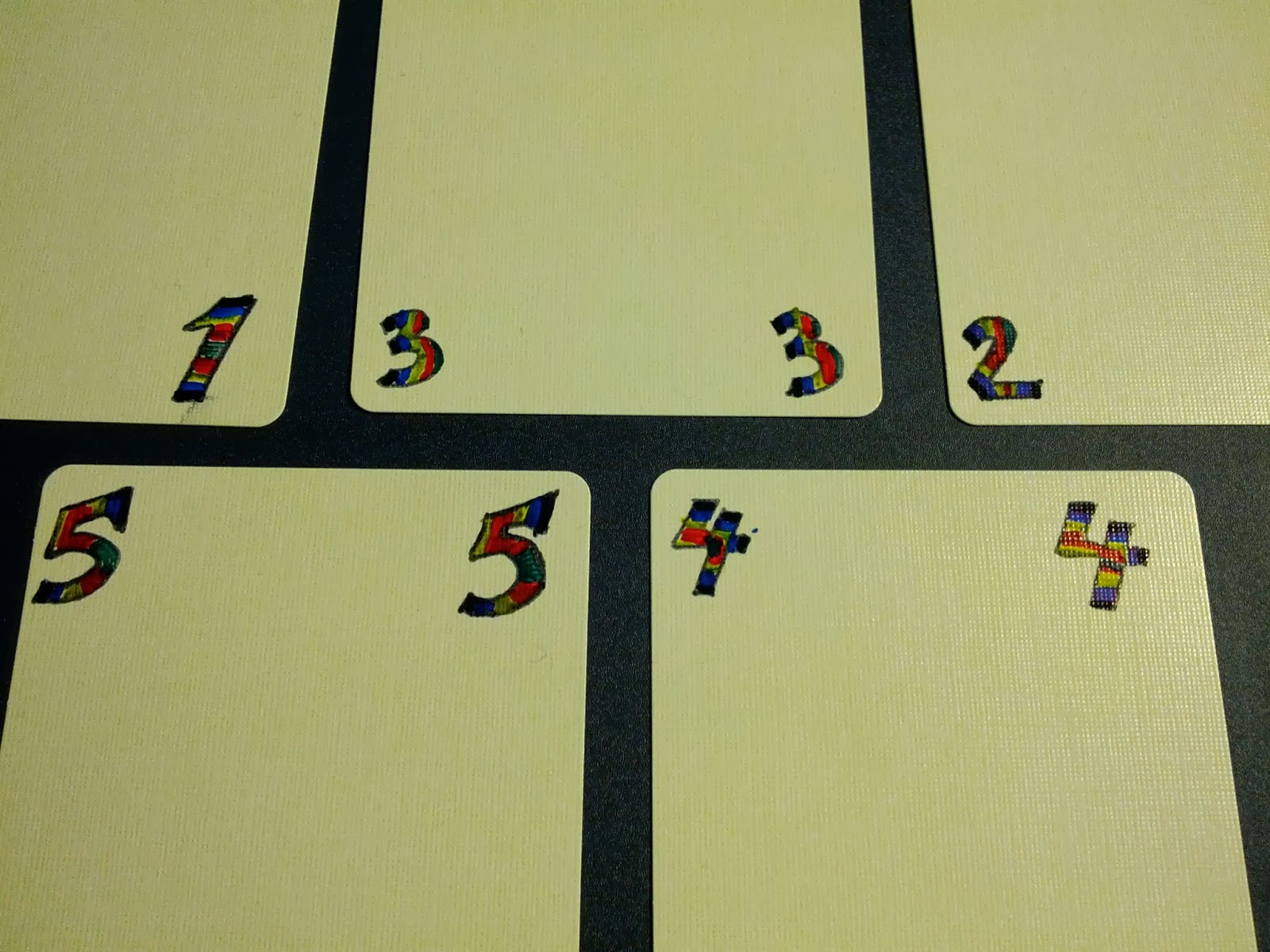
Permanent marker on a blank Bicycle playing card can get a lot
of detail - more than enough for half a card.
I've gotten packs of blank faced Bicycle cards through Amazon on occasion (recently I purchased some blank decks to make a personal version of Hanabi since I couldn't find the game through retail outlets), so testing this scaling adjustment seemed to be pretty easy. I split some extra cards in half to see how they'd be. (I recommend a paper cutter for doing this instead of scissors - your hands will thank you)

Since each blank set was 56 cards, splitting the cards in half made it 112 (with no room for error). The base set of Dominion supports 2-4 players, and minimally requires 254 (3x8 minimum victory cards, 10x10 supply cards, and 60+40+30 treasure cards), so I had to reduce the set to 224 to keep the cards manageable and not hack up a third set of cards. I worked around this by restricting this solution to 2 players and then removing 10 of each treasure card type, since if you're going through any of those supplies in a 2-player game you're doing it wrong.

The Progression of building Victory Points
All cards were they drawn using permanent marker, and I think they look pretty ok. I didn't want to be intricate with drawing these cards for a few reasons:

  1. This is only meant to be a portable learning set, not a replacement for the game.
  2. There was no room for error; I didn't want to waste any cards.
  3. Tediousness; even only for two players I was still applying permanent marker to 224 cards.
  4. I already own the cards, so why would I want to make a pretty set when I could use what I own?

In the end I got through drawing everything over 2 nights, and several hours per night. I don't recommend doing this unless you're a patient person with stuff like this.


Conclusion

You can see the end product in a little Instagram video here: http://instagram.com/p/dTa9zbpZFw/. It'll fit in two back jean pockets easily and play for 2 players without being unreasonably tiny. Cost would minimally be about $10 if you have the markers already, and probably about 8 hours of patience.
"Dominion Pocket" : Includes the Base Set Recommended
Starting Supply and resources for a 2-Player game. No rules,
but that's why there's the Internet. [Instagram]
One of the main reasons I give myself these little projects is that it helps me think about the products I purchase, and their construction. I think it's similar to carpenters eyeing IKEA furniture as a baseline for their own personal projects, and maybe I'd do that to if I had the tools and the space (one of the downsides to apartment life, though if TechShop was closer than Pittsburgh these posts would be about tables instead of table games).

In any case, this was a little different from previous Dominion posts, more in line with my posts about reconstructing games than storing them. Hope it was at least a little interesting to you. If not, I'm sure we can all look forward to Dominion X-TREME in the near future.

Tuesday, August 13, 2013

Hanabi

Introduction

This year's Spiel des Jahres winner is a game called Hanabi. It's a cooperative card game, where the players are working on creating a fireworks display using a hand of cards exposed to all players but the owner. You hold your hand of cards backwards the entire game, so other players tell you the types of cards in your hand. There was a gameplay for it made available (along with the other Spiel des Jahres nominees) through the BoardGameGeekTV channel on YouTube. It's a little long, but the gameplay is the first 12 minutes, and it's a great example game to watch.


I really appreciated the game mechanics, and I went to a local game store to see if they had it. They sadly did not, and a couple websites I checked also didn't have the game available to order (as of this writing). So over the evening I took it on myself to make my own version. I had purchased a couple blank decks of Bicycle Cards through Amazon a few months ago, and this deck sounded simple enough to make.

Making a Deck

5 Permanent Markers and a $4 pack of blank playing cards.
I stuck with the 5 colors of the original game, and I tried to stick with the fireworks theme as much as permanent markers can allow (granted the green fireworks look like palm trees, but whatever).
Examples of the 5 colors.
Writing the numbers took maybe 15 minutes with drying time. The additional firework drawings added some more time, though that was more because I could use more of the permanent marker colors I had beyond the 5.

The cards mostly completed.
 In the rules I also read there are additional cards for a more difficult variant - where these five cards count as every color. The Bicycle blanks had 56 cards total, so I used five for the muilticolored cards. The last will probably include the scoring notes (for instance, 0-5: Horrible ... 25: Legendary).

Multicolored cards for the "Avalanche of Colors" variant.

Conclusion

In the end I'm pretty happy with the results - for not doing a whole lot of work. And I get to play the winner of the Spiel des Jahres now instead of trying to dig around for something. I'll probably get the real game eventually, but in the meantime crafting my own version will get me playing a good new game when it becomes scarce.

Wednesday, July 17, 2013

Dominion Storage Solutions, Version 2

Introduction

A little while ago I mimicked a Dominion storage solution I found on a website, cutting a few corners to reduce cost (if you missed it, it's here). I first wanted to mention a few minor changes I made to the initial design (found here) and then talk about a second design that consolidates cards better and is a more portable solution than what I started with.

Version 1.0 adjustments

Version 1 mainly constituted of a couple acrylic card boxes.
I made a couple additional changes as I noticed some little annoyances when using my initial model. Neither change was that drastic, but I've found they're nice little adjustments to have made.

The first problem I had was the lid not closing if the tabs were vertically upright. To fix this, I trimmed each tab about 1/8" from the bottom (or halfway to the index card's next blue guide line). It was a little time consuming, but it worked out well. The tabs still stuck out and were readable; I guess I didn't need as much clearance with the tabs as I initially thought.

Tab sliced, above a tab that wasn't sliced.
The bottom part is the difference between the index cards.
The second problem I had was when tabs fell over in the acrylic case - sometimes it was a little tricky to pick them up, especially when they shifted under other cards and tabs. My brother made a great suggestion of slicing a coffee stirrer vertically with a razor blade and putting one on either side of the card to act as a little bumper. If you cut a standard coffee stirrer into quarters, you're able to add bumpers to 2 index cards per stirrer.
Tab after adjustments.
You can get stirrers in bulk at a store like Staples. If you want to test out the idea I found my local Qdoba had some on hand.

Version 2.0

Although I liked my initial solution, I wasn't particularly thrilled with it for portability. I currently own Dominion (base game), Intrigue, Hinterlands and Guilds and it was 3 card boxes to carry everywhere. On the one hand it was nice that I could pick and choose what to take (since I'm introducing people to Dominion still I don't usually need to take anything beyond the base set and Intrigue with me), but that's still 2 card boxes to take and I can do better.

Additionally I had carry games in recyclable tote bags, and those card cases are a little larger than those standard sized bags. I've been noticing my bags starting to have holes wearing through them, and it looks like it's due to those longer boxes.

Boxes

I think we need a bigger box.
I had a 40% off coupon to Michael's so I went browsing. I stumbled upon a Large Photo and Craft Keeper by Iris, which is meant to hold 4x6 photos. With those dimensions it seemed like I could put two stacks of cards per box. Assuming each box holds 2 stacks of 60, that'd be about 120 cards x 16 boxes for 1920 cards. Though all Dominion sets [based on Wikipedia data] add up total 2850, it sounded like this would handle the 1450ish cards that I currently had.

I chose to take a cheap route to splitting each box in half, folding a regular envelope up to become a tray.

Doubles as a paper airplane.
I chose to mostly keep the supply cards bundled by set still (at least for Intrigue and the base set), though I may move away from this soon.

Tabs

Playing with tabs.
I liked the ease and cheapness in making tabs with index cards, so I chose to stick with that. This time around though, after a little bit of thought, I moved more toward vertical tabs. I liked the tabs from my first attempt a lot - I liked the readability and the color coding of each tab to make them easy to find, but with this effort I had two major hurdles to go though.

The first problem was how to get the tabs mixed in with the cards and be as readable as possible. Between looking through the plastic and looking all around the edge of the case to read the contents, I decided against large tabs and opted for little numbered tabs.

Sometimes easier is better.
I chose to stick with 6 numbered tabs, with identifying text for each tab on the front of the first tab of the set. I would've liked more, but it was pretty much at the box's capacity. I've been considering adding color to the tabs or the text up front, but I can't say it seems like much of a benefit at this point. While a nice indicator, the color of the Randomizer Cards don't seem to be as important as being organized alphabetically.

After a while I got lazy and only cut one side of the tabs off instead of both. I'm not sure if this approach is better, but it may hold up better over time. I'll have to see how it holds up over time.

The other good thing about not adding color is that I won't feel as bad if I get another set and have to readjust some or all of the tab sets. With the tab information all being on the first card, changing the ordering only requires replacing the (1) tab.

One card box containing 12 sets of Supply cards.

Result

Version 2: Less colorful right now, but more portable.
When I finished up, I had a box with a handle that contained all my cards easily. While it doesn't look like it'll hold all Dominion cards, I like how it's a compartmentalized solution; should I wish to take a subset of cards, I can mix and match easily, or just take the packs I need (if I organize them effectively).

Top Cards and Tabs roaming free in their boxes. ಠ_ಠ
There are still some little inconveniences though. Some of the tabs/cards slide around in the individual boxes, in spite of my efforts to prevent it from happening. I'll probably wait a little bit before considering how to correct this though, since I'm not sure if it's that big a problem. If it's only the top card or two, I'd rather they shift a little in transport than adjust the boxes so I lose more space.

Because I really don't want to confuse Randomizer Cards
with all the other cards.
Also there's a matter of labeling. Since there are now many little boxes I'd have to take them all out to see their contents. I'm considering stickers or tape labels to help with identification (I used painter's tape to label some things like the Randomizer Cards, but that was along the front). I'm also considering taping a guide/map on the inner part of the box for identifying the smaller boxes.
If only there was something on the top part of the box
to describe the bottom part of the box. Hmm.

Conclusion

So this is what I have at the moment. As you can read, there are a few more things to adjust, and my overall goal remains working toward an economical version of the kickstarter I initially saw. I think I'm getting closer, but there's still a way to go from here. If you have any suggestions feel free to let me know via the comments here, or wherever (Facebook, Twitter, Google+, email, etc.)

Tuesday, July 9, 2013

Scrabble with Numbers

When I was a kid my grandmother had an old game called Numble that I would take out once in a while and try to play. Honestly, it wasn't a very good game - the idea was pretty much Scrabble but with numbers, and the rules were a little too boring for me - especially when I was 6 or so. I think my brother and I usually opted for Upwords instead - at least with that game you could stack the letter tiles and I guess pretend they were Legos or something.

Numble from 1968 [video on Instagram]
Decades later I picked up the game from my grandmother. Although I didn't care for it as a child, it was one that nostalgically grew on me as I got older. Don't get me wrong, it's still a boring game (there's a reason it's no longer in print) but I guess I can blame Scrabble for my picking it up. In college I began to understand and appreciate the mechanics more for Scrabble (and I also got much more competitive and cutthroat with the game).

Numble originally came out in 1965 - 17 years after Scrabble, and was styled with a lot of similarities to the game. It had a board with double letter (number) and word (sequence) scores, and had structural rules behind it (sequences had to be in ascending or descending order and be divisible by 3). The rules actually translated to scrabble well, but it just wasn't as fun.

The problem I felt was that numbers were boring compared to letters. 26 letters with variable frequency led to challenging word decisions that didn't exist with Numble's 10 number options (and blanks). Numbers varied in frequency, but it really wasn't the same - it was harder to get excited about getting a 9 versus getting a Z or X in scrabble. Another thing was that your points were relative to the points on the tile, so a 9 was 9 points, a 5 was 5 points, etc. This meant that 9s were almost always playable at the end of most sequences (add a 9 digit to any sequence and it's still divisible by 3), and could be the beginning of a new perpendicular sequence. 9s were broken tiles in the games of Numble that I played.

So let's fast forward to a game that popped up on Kickstarter over the last few days called Yushino.


I have pretty mixed opinions on the game they're offering (they have a web app you can try if you want). On the one hand, I do find it interesting that the game idea is has come around again. On the other hand, I don't know if its game mechanics have that much more to offer than Numble had. Yushino's rules are almost as simple as Numble's rules were: Sequences of 2 have to differ by 1 (Nk = 1 ± Nk+1), and Sequences of 3 or more have to follow the rule of each digit being the last digit of the sum of the previous two (or Nk+2 = (Nk + Nk+1) mod 10). The benefit I noticed was that it keeps the digits from getting clumped in order like Numble did. However, the disadvantage remains that the digits represent the points as well. Playing the game, it feels more and more that your victory in the game is partly based on experience, but still has a bit of a luck factor on pulling 9s. In one online game I tried I managed to get a hand cluttered with 0-3 point tiles, and it was a miserable game for me.

I love a game where it's possible to play tiles
and get zero points out of the turn.
I do think Yushino's a good progression on the Number Scrabble idea - but I think my biggest problem is that the Number Scrabble concept just isn't as challenging or fun to me. If I want a Scrabble-like game, I'll just play Scrabble. If I want a more number-oriented game, I'll play a game more oriented toward bidding or heavy strategy like Power Grid, or play a shorter game with simple math like Zombie Dice. Or I'll just cut up some index cards, write numbers on them and use a Scrabble board if I'm really jonesing for a Numble variant. At least then the investment is minimal.

There's a bit of time before the Kickstarter ends if you want to support it by 31 July 2013. It's also nice that it is available in other mobile device forms, so you can see if it's something you think would be worthwhile (or you could just play it that way and not have to worry about doing math at all). I won't be backing it though; I have never had a board game collect as much dust as Numble over the years, and don't want to see about getting another one.