Monday, August 26, 2013

Dominion in a Smaller Form Factor

Introduction

It's time for another one of Tom's crazy arts and crafts projects. This takes another look at Dominion, a game I've tried to work out my own storage solutions for, as addressed in previous posts.

This time though I want a different discussion about Dominion. Over time I've noticed it's harder to get people interested in playing this game. There are many reasons for this:

For one, the game looks pretty boring, and overall consensus is that this game is pretty much theme-less. The bland conventional style doesn't really hold up against other games on a shelf at a Barnes & Noble. I fully admit it took me years to buy Dominion (which came out around 2009), and a big part of it was that it was the incredibly uninteresting box. Dramatic games, like King of Tokyo or Smash Up are much easier sell, for instance.
Would you like Giant Monsters Battling, Dinosaurs with Lasers,
or Rolling Fields of Quiet Tranquility?
The second reason was that I heard it compared as a step above Collectible Card Games, or CCGs (the most famous example being Magic: The Gathering). In fact, the game's designer Donald X. Vaccarino expressed that his appreciation for Magic influenced him for this game. As an off-again-on-again Magic player over the years, I avoided the game somewhat because of that comparison, because "inspired by a CCG" doesn't seem like a good selling point to me. The "money pit" aspect of Magic is a pretty large deterrent for me.

When I went on vacation to the Pacific Northwest this year, I stumbled on a different game that I really enjoyed called Nefarious, that I discovered was also by Vaccarino. Also, a friend of mine raved about Dominion while I was out there, so I chose to bite the bullet and try it out.

The third reason Dominion is a hard sell is because it's kinda unwieldy. If you stuffed them into a 250-card paper box you'd probably do ok, but then you'd have what looks like a card game in a paper box. See reason #1 again - presentation really helps. When I've carried my storage solutions for Dominion around I've felt eyes on me with the same flat stare of the guy selling "real Rolexes" on the street corner with his overcoat.

I've really been relying on these posts to be a partial selling point for Dominion, because unless I start making Dominion X-TREME (The Smithy picture [tentatively!] will have Thor and a Laser Anvil for instance), this game will only really spread by word of mouth.

The third point is what leads me to the main part of this post. I want people to get interested in this game, but I can't lug around huge boxes of cards with me all the time. So what can I do about this?

A Matter of Scale

One of the things that dawned on me when I started thinking about this problem is that Dominion cards were - somewhat unnecessarily - the size of playing cards. Though these cards get filled with card descriptions and artwork, you really don't need any of it outside of the name. So my first thought was to split the size of the cards in half. Conceptually this would also help with carrying all these cards around since it would halve everything, including size and weight.

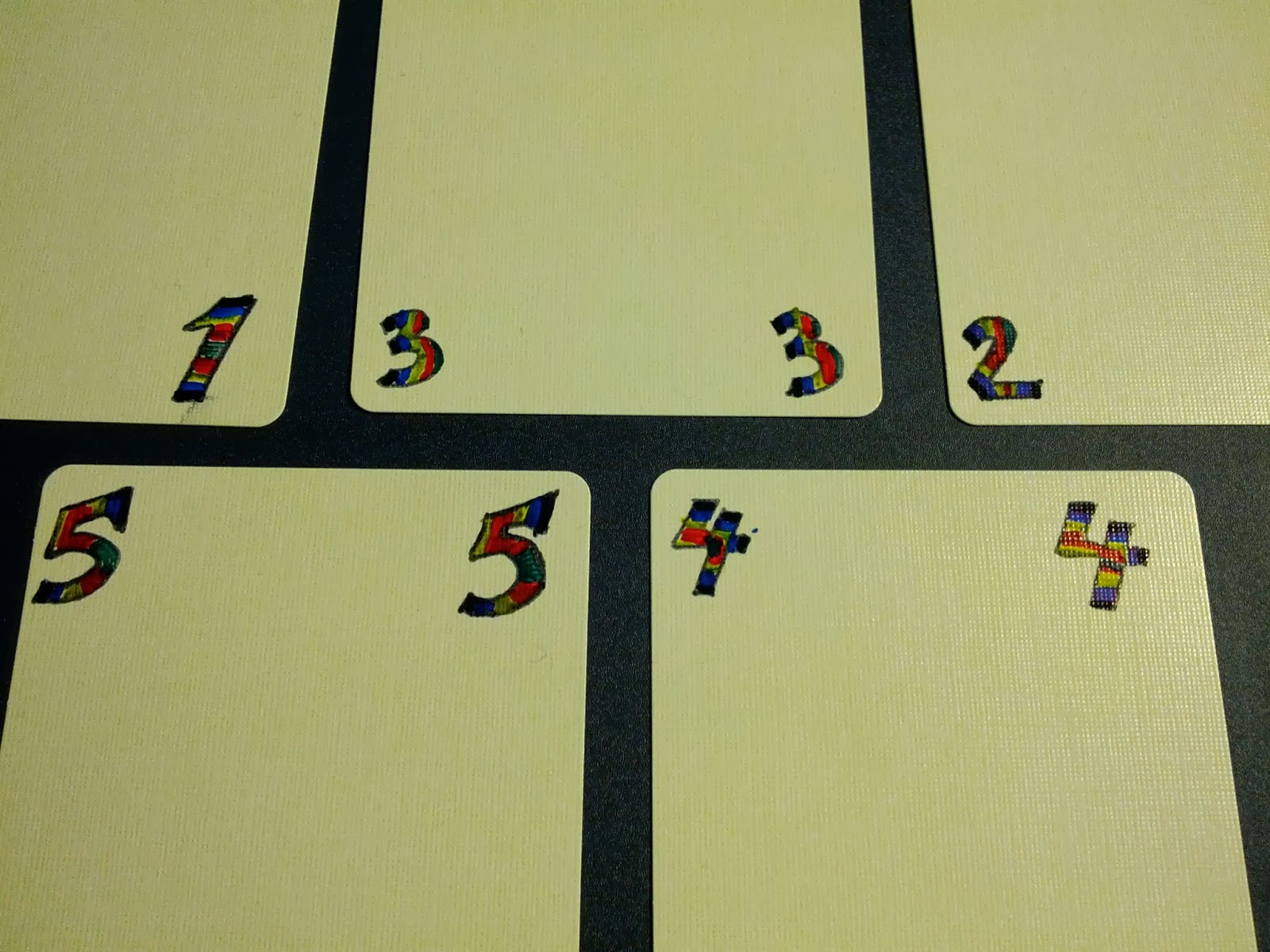
Permanent marker on a blank Bicycle playing card can get a lot
of detail - more than enough for half a card.
I've gotten packs of blank faced Bicycle cards through Amazon on occasion (recently I purchased some blank decks to make a personal version of Hanabi since I couldn't find the game through retail outlets), so testing this scaling adjustment seemed to be pretty easy. I split some extra cards in half to see how they'd be. (I recommend a paper cutter for doing this instead of scissors - your hands will thank you)

Since each blank set was 56 cards, splitting the cards in half made it 112 (with no room for error). The base set of Dominion supports 2-4 players, and minimally requires 254 (3x8 minimum victory cards, 10x10 supply cards, and 60+40+30 treasure cards), so I had to reduce the set to 224 to keep the cards manageable and not hack up a third set of cards. I worked around this by restricting this solution to 2 players and then removing 10 of each treasure card type, since if you're going through any of those supplies in a 2-player game you're doing it wrong.

The Progression of building Victory Points
All cards were they drawn using permanent marker, and I think they look pretty ok. I didn't want to be intricate with drawing these cards for a few reasons:

  1. This is only meant to be a portable learning set, not a replacement for the game.
  2. There was no room for error; I didn't want to waste any cards.
  3. Tediousness; even only for two players I was still applying permanent marker to 224 cards.
  4. I already own the cards, so why would I want to make a pretty set when I could use what I own?

In the end I got through drawing everything over 2 nights, and several hours per night. I don't recommend doing this unless you're a patient person with stuff like this.


Conclusion

You can see the end product in a little Instagram video here: http://instagram.com/p/dTa9zbpZFw/. It'll fit in two back jean pockets easily and play for 2 players without being unreasonably tiny. Cost would minimally be about $10 if you have the markers already, and probably about 8 hours of patience.
"Dominion Pocket" : Includes the Base Set Recommended
Starting Supply and resources for a 2-Player game. No rules,
but that's why there's the Internet. [Instagram]
One of the main reasons I give myself these little projects is that it helps me think about the products I purchase, and their construction. I think it's similar to carpenters eyeing IKEA furniture as a baseline for their own personal projects, and maybe I'd do that to if I had the tools and the space (one of the downsides to apartment life, though if TechShop was closer than Pittsburgh these posts would be about tables instead of table games).

In any case, this was a little different from previous Dominion posts, more in line with my posts about reconstructing games than storing them. Hope it was at least a little interesting to you. If not, I'm sure we can all look forward to Dominion X-TREME in the near future.

Tuesday, August 13, 2013

Hanabi

Introduction

This year's Spiel des Jahres winner is a game called Hanabi. It's a cooperative card game, where the players are working on creating a fireworks display using a hand of cards exposed to all players but the owner. You hold your hand of cards backwards the entire game, so other players tell you the types of cards in your hand. There was a gameplay for it made available (along with the other Spiel des Jahres nominees) through the BoardGameGeekTV channel on YouTube. It's a little long, but the gameplay is the first 12 minutes, and it's a great example game to watch.


I really appreciated the game mechanics, and I went to a local game store to see if they had it. They sadly did not, and a couple websites I checked also didn't have the game available to order (as of this writing). So over the evening I took it on myself to make my own version. I had purchased a couple blank decks of Bicycle Cards through Amazon a few months ago, and this deck sounded simple enough to make.

Making a Deck

5 Permanent Markers and a $4 pack of blank playing cards.
I stuck with the 5 colors of the original game, and I tried to stick with the fireworks theme as much as permanent markers can allow (granted the green fireworks look like palm trees, but whatever).
Examples of the 5 colors.
Writing the numbers took maybe 15 minutes with drying time. The additional firework drawings added some more time, though that was more because I could use more of the permanent marker colors I had beyond the 5.

The cards mostly completed.
 In the rules I also read there are additional cards for a more difficult variant - where these five cards count as every color. The Bicycle blanks had 56 cards total, so I used five for the muilticolored cards. The last will probably include the scoring notes (for instance, 0-5: Horrible ... 25: Legendary).

Multicolored cards for the "Avalanche of Colors" variant.

Conclusion

In the end I'm pretty happy with the results - for not doing a whole lot of work. And I get to play the winner of the Spiel des Jahres now instead of trying to dig around for something. I'll probably get the real game eventually, but in the meantime crafting my own version will get me playing a good new game when it becomes scarce.

Sunday, July 28, 2013

Midnight Party 1/3 : Oh Look, An Art Project.

Introduction

So I've mentioned Midnight Party a few times now in recent posts. This game was very much a kid's game (supports ages 4 and up) from 1989. It was designed by Wolfgang Kramer, who years later would create several games of greater popularity (like El Grande, The Princes of Florence, Torres, Colosseum, Category 5, and his Mask Trilogy of games).
The box (above) and rules were destroyed by water. You can
see some of the damage on the upper part of the box.
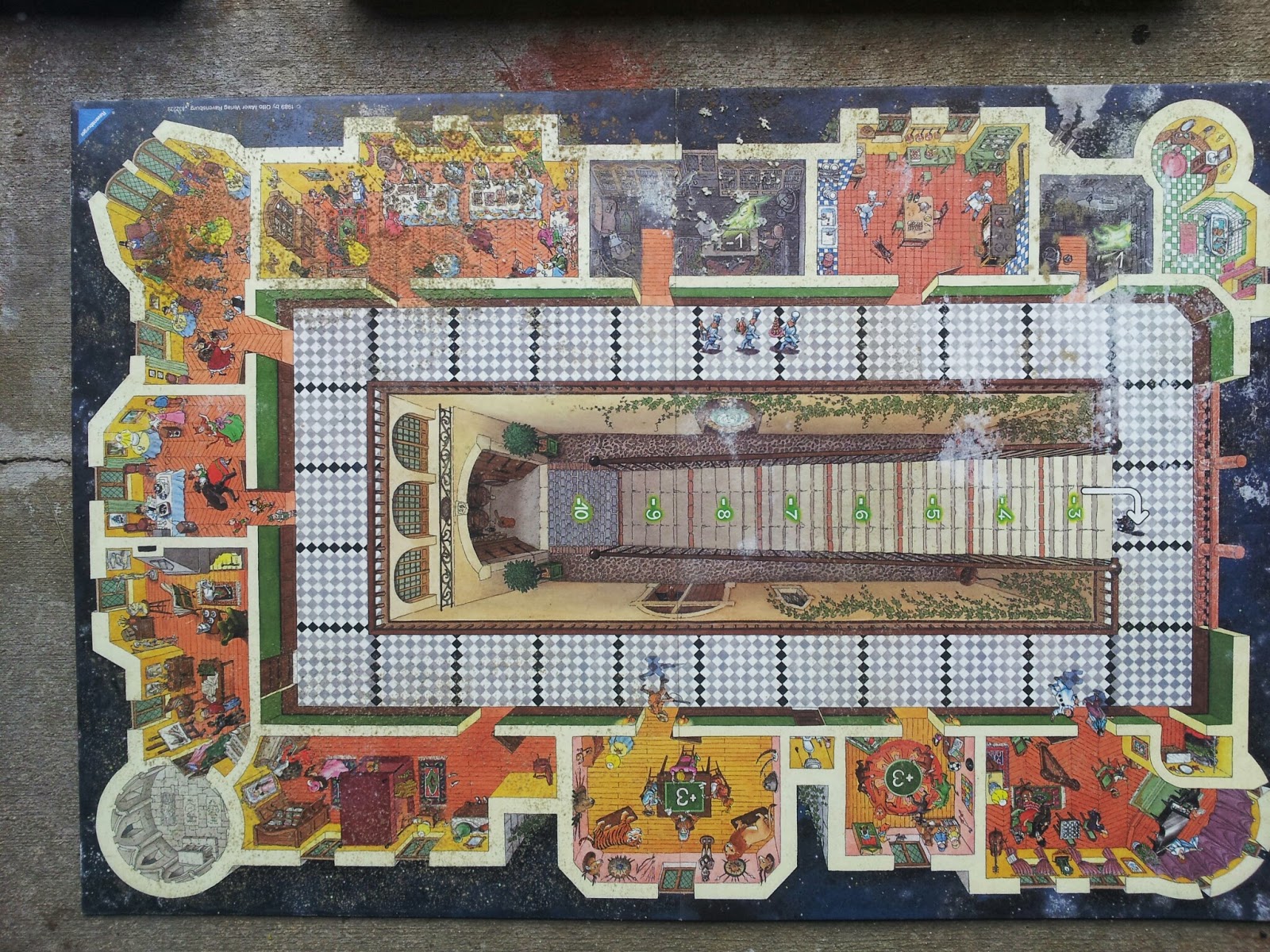
I remembered liking Midnight Party fondly as a kid, probably because of the wonderful theme and simple rules behind the game. The ghost in the game (Hugo) has a birthday party, and all the players control guests playing hide and seek with him for 3 rounds. When Hugo comes out from the cellar everybody needs to find a room to hide in for points. Those captured by Hugo receive penalty points.
Early sketch, just playing around. [Instagram]
While I don't think this game holds up 100% over time (it's a fairly random game), I like a few aspects of it. The pieces are well made, and for its time the board projected the theme very well. Additionally, I like that it works for 2-8 players, which is a rarity in a lot of board games.

The pieces that were still good were:

  • Hugo the Ghost
  • Ghost die (d6 with 1, 2, 4, 5 and 2 Ghost faces replacing the 3 and 6)
  • 30 Guests
    • 6 Blue and Red (for a 2+ player game)
    • 5 Turquoise (for a 3+ player game)
    • 4 Yellow (for a 4+ player game)
    • 3 Black (for a 5+ player game)
    • 2 Purple, Green, White (for a 6-8 player game)

Design

The only thing I really need to rework is the game board. The problem is that I really want this to be as visually captivating of a game as I can make it. In order to do this I started taking one approach, and then started along a secondary one. Neither are finished yet, but I think enough process has been hashed out to at least start talking about these designs. I plan to complete both designs in the future.
I took general and detailed pictures of the board to
try and capture as much detail as possible.
(The upper left part was in pretty bad shape though)
Initially I wanted to make a basic paper replication of the game, so I could have a quintessential board to work off of like I did for Pipeline. Nothing really amazing with that - paper and Rapidograph pen as usual.
Game board with some measurements and added notes.
Some board/box sketches.
above: assembled, below: separated.
As I was looking at it though, I recalled how I always wished the cellar on the board was more like an actual cellar - with some depth and character built in. Given this thought, I set to work on making a box for this quartered board, so when opened, the room panels could lay across the box and the inside act as the cellar.

I sketched out some ideas on how to accomplish this kind of presentation and eventually came up with the idea on the right. Pretty much the idea is to try and have a shallow box for pieces to keep the cellar from being so steep that pieces can't stay on the tilt.

I got some wood and additional components from Home Depot and then went to Michael's for some Acrylic paint to paint the boards with. I figured since this painting part would probably take the most time, I should start looking into getting a heads start on it. I chose acrylic paint because I knew it would provide bold colors and dry quickly, but it had also been at least a decade since I cracked open acrylic paint.

Revelation

I was looking at some canvases to practice painting with acrylics on and then it hit me: For some games, I could paint the boards on canvas and store them as such. It was a fascinating idea - the board as art and the pieces stored behind the canvas. I'm sure some of the inspiration came from getting CO2 recently (the watercolor look is beautifully striking), but I think a majority of the idea game from Solarquest. Up until this point I was considering learning how to make my own [typical] game board (this still may occur), but the idea of working tirelessly on painting a board that would just get stored in a box seemed a little demoralizing.

I picked up a 10"x20" canvas and got started on another game board for Midnight Party testing this idea out (I used Midnight Party because its board is both smaller and more difficult than the Solarquest board - pretty sure I can paint planets). Here are the results after each round of painting so far:

Round 1 (Basic layout)
Round 2 (Early text and detail)

While not yet complete, I think these can kinda show how I'm thinking this could work. Furthermore I think if I can add something that would allow pieces/rules to be stored behind the canvas (without much increase in weight), this may be a really neat way to present games to people. "Hey, you want to play chess? Here, let me pull it off the wall for you."

Game pieces on canvas. See an unnecessary autoawesomed
version of this at the bottom of this, courtesy of Google+ .
In the end, I think it's a really neat idea for board games - and for art. Art for me has really escalated more and more toward pretentiousness and elitism in a way that saddens me. I personally don't think that brand of art has much higher to climb though; my two most recent New York trips had MoMA highlighting artists that were either reviewed in their own Ivory Towers, or "Gimmicky Diversions". I've come to appreciate more of the less pretentious art over the years, and I feel the more sincere pieces can hold up better in time and appreciation. In my lifetime I'd love to see an artist with the passion of Van Gogh over the extravagance of Dali for instance.

Conclusion

So initially I had one board idea and game out with two. My intention at this point is to complete the canvas version in the near future and look at a Solarquest board next (unless something else catches my eye more). On the side, I'm hoping to construct my initial box and board design, although I know there's more construction involved in this one.

Bonus: Unnecessary Autoawesome

Google+ has an effect called "Autoawesome" that gets applied to a sequence of similar pictures taken over a short timeframe. While I find them distracting to the post, it's kinda fun to see what they do. So here you go.

I guess it's a good way to see that these pieces do, in fact,
have three dimensions.
It was hypnotic enough that I felt the need to add it in.

Sunday, July 21, 2013

Pipeline

Introduction

As I've mentioned in an earlier post I've recently been inspired by some older games for this blog. Mainly, family games that have been moderately destroyed because of water damage. I'll try to post about games that I rediscover, as well as the games that are pretty much destroyed. Previously I talked about the two games I acquired: APBA Baseball (1951,1975) (which was almost entirely ruined), and Pipeline (1988) (which had the board and rules discarded). This post is going to talk about rebuilding the Pipeline game, as well as pulling pieces from two more games over this weekend: Solarquest (1985) and Midnight Party (1989).
Pipeline (1988): "A game that combines strategy, tactic(s?), and luck -
making this game absorbing, challenging, and fun!"

Pipeline

My intention in these posts is less about game play and more about reconstruction (without expense), but here's the gist of game play (fully available on BGG):
The objective is to create a pipeline from the center of the board ("oil well") to an oil tanker's "loading dock" square. Each player draws a hand of 5 pipes and plays one per turn, replenishing only when their hand is empty. The oil derricks are meant to obstruct straight paths to victory.
This was Games Magazine's 1992 Game of the Year, and was a bit of an anomaly because it is the only game ever produced from its designer and publisher. Personally I don't recall great game experiences playing this, but it seemed like a good game to try cleaning up first.

Pieces destroyed:


  • Game board
  • Rules

Pieces recovered:


  • Game tiles:
    • 120 Straight Pipes
    • 37 Elbow Pipes (I had 38)
    • 27 T-Pipes
    • 11 Cross Pipes
    • 5 Plugs
  • 4 tile stands
  • 1 6-sided Die (only to determine starting player - really?)
  • 1 Cloth bag
As mentioned previously, all the pieces were first washed off cleaned up and counted. This also gave a good way of assessing the condition of everything. I also threw the cloth bag into the washer and dryer.
Cleaning tiles and tile racks.

Alterations and Reconstruction

I'm reconstructing these games solely with the intention of making the games playable again at this point, and not trying for accurate game reproductions. If a game garners enough interest (or if the product is more meaningful to me), I'll aim toward investing more into making the game look nicer, but for the time being the board is constructed with heavy card stock, drawn over using a ruler and rapidograph pen.
Originally these were fixed to the board. I made them
into additional tokens instead. [Instagram]
Another thing I'm doing for the purposes of this game is componentizing the pieces a little more. When first drawing out the 15 x 15 board (as 9 5x5 squares), I came to the realization that drawing the oil well and oil derricks would restrict the grid to only be used for this game, and would additionally restrict the configuration options. Considering my memories of this game are pretty meh to begin with, I wanted to make the pieces a little more flexible if there was a better way to configure the board.
Pipeline was never a very flashy game to begin with :-/
The original board also had colors set in the board for the players, but this seemed unnecessary considering people would sit in front of their part of the board anyways. I may add color back in, if only so people can diversify their loading dock positions, but it hardly seems worth it at this point.

Next Games / Conclusion

All that's left of Solarquest and Midnight Party.
When I went home this weekend, my intention was at least to pick up Solarquest, since I was terribly curious how much of it was salvageable. My dad had started moving games to the garage, so I saw another game that I chose to clean up as well called Midnight Party. Solarquest is a similar game to Monopoly but set in space (and with other differences), while Midnight Party is a Wolfgang Kramer game, a game designer best known later on for other games like El Grande, Torres and Tikal.

Hopefully I'll be writing about at least one of these games in the coming weeks. I do know both of these games have much more involved game boards though, and I would prefer to see if there are good ways to construct comparable game boards. So we'll see how much difficulty there will be in reviving these games.

Wednesday, July 17, 2013

Dominion Storage Solutions, Version 2

Introduction

A little while ago I mimicked a Dominion storage solution I found on a website, cutting a few corners to reduce cost (if you missed it, it's here). I first wanted to mention a few minor changes I made to the initial design (found here) and then talk about a second design that consolidates cards better and is a more portable solution than what I started with.

Version 1.0 adjustments

Version 1 mainly constituted of a couple acrylic card boxes.
I made a couple additional changes as I noticed some little annoyances when using my initial model. Neither change was that drastic, but I've found they're nice little adjustments to have made.

The first problem I had was the lid not closing if the tabs were vertically upright. To fix this, I trimmed each tab about 1/8" from the bottom (or halfway to the index card's next blue guide line). It was a little time consuming, but it worked out well. The tabs still stuck out and were readable; I guess I didn't need as much clearance with the tabs as I initially thought.

Tab sliced, above a tab that wasn't sliced.
The bottom part is the difference between the index cards.
The second problem I had was when tabs fell over in the acrylic case - sometimes it was a little tricky to pick them up, especially when they shifted under other cards and tabs. My brother made a great suggestion of slicing a coffee stirrer vertically with a razor blade and putting one on either side of the card to act as a little bumper. If you cut a standard coffee stirrer into quarters, you're able to add bumpers to 2 index cards per stirrer.
Tab after adjustments.
You can get stirrers in bulk at a store like Staples. If you want to test out the idea I found my local Qdoba had some on hand.

Version 2.0

Although I liked my initial solution, I wasn't particularly thrilled with it for portability. I currently own Dominion (base game), Intrigue, Hinterlands and Guilds and it was 3 card boxes to carry everywhere. On the one hand it was nice that I could pick and choose what to take (since I'm introducing people to Dominion still I don't usually need to take anything beyond the base set and Intrigue with me), but that's still 2 card boxes to take and I can do better.

Additionally I had carry games in recyclable tote bags, and those card cases are a little larger than those standard sized bags. I've been noticing my bags starting to have holes wearing through them, and it looks like it's due to those longer boxes.

Boxes

I think we need a bigger box.
I had a 40% off coupon to Michael's so I went browsing. I stumbled upon a Large Photo and Craft Keeper by Iris, which is meant to hold 4x6 photos. With those dimensions it seemed like I could put two stacks of cards per box. Assuming each box holds 2 stacks of 60, that'd be about 120 cards x 16 boxes for 1920 cards. Though all Dominion sets [based on Wikipedia data] add up total 2850, it sounded like this would handle the 1450ish cards that I currently had.

I chose to take a cheap route to splitting each box in half, folding a regular envelope up to become a tray.

Doubles as a paper airplane.
I chose to mostly keep the supply cards bundled by set still (at least for Intrigue and the base set), though I may move away from this soon.

Tabs

Playing with tabs.
I liked the ease and cheapness in making tabs with index cards, so I chose to stick with that. This time around though, after a little bit of thought, I moved more toward vertical tabs. I liked the tabs from my first attempt a lot - I liked the readability and the color coding of each tab to make them easy to find, but with this effort I had two major hurdles to go though.

The first problem was how to get the tabs mixed in with the cards and be as readable as possible. Between looking through the plastic and looking all around the edge of the case to read the contents, I decided against large tabs and opted for little numbered tabs.

Sometimes easier is better.
I chose to stick with 6 numbered tabs, with identifying text for each tab on the front of the first tab of the set. I would've liked more, but it was pretty much at the box's capacity. I've been considering adding color to the tabs or the text up front, but I can't say it seems like much of a benefit at this point. While a nice indicator, the color of the Randomizer Cards don't seem to be as important as being organized alphabetically.

After a while I got lazy and only cut one side of the tabs off instead of both. I'm not sure if this approach is better, but it may hold up better over time. I'll have to see how it holds up over time.

The other good thing about not adding color is that I won't feel as bad if I get another set and have to readjust some or all of the tab sets. With the tab information all being on the first card, changing the ordering only requires replacing the (1) tab.

One card box containing 12 sets of Supply cards.

Result

Version 2: Less colorful right now, but more portable.
When I finished up, I had a box with a handle that contained all my cards easily. While it doesn't look like it'll hold all Dominion cards, I like how it's a compartmentalized solution; should I wish to take a subset of cards, I can mix and match easily, or just take the packs I need (if I organize them effectively).

Top Cards and Tabs roaming free in their boxes. ಠ_ಠ
There are still some little inconveniences though. Some of the tabs/cards slide around in the individual boxes, in spite of my efforts to prevent it from happening. I'll probably wait a little bit before considering how to correct this though, since I'm not sure if it's that big a problem. If it's only the top card or two, I'd rather they shift a little in transport than adjust the boxes so I lose more space.

Because I really don't want to confuse Randomizer Cards
with all the other cards.
Also there's a matter of labeling. Since there are now many little boxes I'd have to take them all out to see their contents. I'm considering stickers or tape labels to help with identification (I used painter's tape to label some things like the Randomizer Cards, but that was along the front). I'm also considering taping a guide/map on the inner part of the box for identifying the smaller boxes.
If only there was something on the top part of the box
to describe the bottom part of the box. Hmm.

Conclusion

So this is what I have at the moment. As you can read, there are a few more things to adjust, and my overall goal remains working toward an economical version of the kickstarter I initially saw. I think I'm getting closer, but there's still a way to go from here. If you have any suggestions feel free to let me know via the comments here, or wherever (Facebook, Twitter, Google+, email, etc.)

Sunday, July 14, 2013

Rolling for Initiative (or Blogging with Inspiration)

Introduction

So I went home recently looking for an older game I was talking about at work. It was called "APBA Baseball" and although originally published in 1951, the version we had was probably from the 1970s or 1980s. To briefly summarize the game, there was a base game you bought, and then every year they released a set of all players as an annual expansion to the game. Sort of like Madden football video games, but as a board game. With you and your opponent each choosing a team set, you could play each other using the players from that team in that year, with dice incorporating a randomization factor. I don't recall playing it a whole lot, but it was an interesting concept. When fantasy football started becoming a mainstream internet attraction, this was the first thing I remembered.

Here's an amazing video about it from the New York Times five years ago:


Interestingly, this board game is still a thing, even after 70 years, and it covers most major sports including Football, Soccer, Hockey, Basketball and Golf. So if this sounds of interest to you it can be purchased initially for about $25 at apba.stores.yahoo.net. But the game isn't really the focus of my story this time around.

Finding the Game

My family had a lot of board games growing up; several of which I loved as a child. We had fun kid's games like Cat's Eye, some dexterity games like Torpedo Run!, and a lot of oddball games. One that sticks in my mind is Solarquest, which was essentially Monopoly in space. It was a more enjoyable game, particularly because it - unlike Monopoly - ended much more quickly. I'm hoping to write about at least some of these games in the future.

When I was living at home over a decade ago, the games were all in the house's family room, and not very well organized. A few years later, most of those games migrated downstairs into the basement (though with some exceptions - games that my brother and I felt specific ownership toward like Hero's Quest or Torpedo Run! stayed out of the basement).

I collected Torpedo Run! from home today. [Instagram]
A while back my dad's basement flooded, and there was a lot of water damage that migrated into the basement. This led to the destruction of a lot of things downstairs, but some of it was noticed more than others (and you can probably tell where this is going). Today my search for this game led us downstairs, and we found out the game in terrible shape. It wasn't going to be salvageable because previous damage, time and neglect tore the game to shreds, and was immediately trashed.
It was really bad. When you can buy the game
today for $25, you may as well trash a box like this.

Pipeline

It's said you can find inspiration in everything, and there in the basement I saw another game called Pipeline (1988) that looked in slightly better shape. On a whim as my dad was bringing APBA Baseball upstairs, I grabbed Pipeline and took it along with me.
Another basement victim, but more salvageable.
I didn't have much hope for APBA Baseball, because I remembered it being almost entirely paper components, but I wanted to see a better example. Pipeline turned out to be a great decision to grab - all the pieces except the board were made of plastic, and the board itself should be relatively easy to reconstruct. I washed the pieces off two clear off dust and whatnot that may have remained after several years out of sight.

"After 20+ years you will find, looking this good you are not."
Pipeline: A game without a board right now.
I plan to reconstruct Pipeline in the next month or two, though I may take a few liberties with the game board. The objective of the game is for each player to build out a pipe from the center of a custom board out to one of their oil tankers at the edge of the game board. Considering that's the only special thing about the board, it may be easier to create obstacle pieces and use a plain game board, so I can use the board for more things in the future.

Inspiration

What remains of the APBA Baseball game - the rest was
all trashed. [Instagram]
In the weeks ahead I will probably attempt to clear out the board games that are in the basement and see what games or parts I can salvage. There were several games of my childhood that I enjoyed down there, and it saddens me to know that some of those may never be played again in their current state. So my hope for the moment is to see what can be saved, and otherwise document as much imagery as I can, extract the pieces that may have a second life one day (either in rebuilding the game or making them backup components), and trash the rest.

Tuesday, July 9, 2013

Scrabble with Numbers

When I was a kid my grandmother had an old game called Numble that I would take out once in a while and try to play. Honestly, it wasn't a very good game - the idea was pretty much Scrabble but with numbers, and the rules were a little too boring for me - especially when I was 6 or so. I think my brother and I usually opted for Upwords instead - at least with that game you could stack the letter tiles and I guess pretend they were Legos or something.

Numble from 1968 [video on Instagram]
Decades later I picked up the game from my grandmother. Although I didn't care for it as a child, it was one that nostalgically grew on me as I got older. Don't get me wrong, it's still a boring game (there's a reason it's no longer in print) but I guess I can blame Scrabble for my picking it up. In college I began to understand and appreciate the mechanics more for Scrabble (and I also got much more competitive and cutthroat with the game).

Numble originally came out in 1965 - 17 years after Scrabble, and was styled with a lot of similarities to the game. It had a board with double letter (number) and word (sequence) scores, and had structural rules behind it (sequences had to be in ascending or descending order and be divisible by 3). The rules actually translated to scrabble well, but it just wasn't as fun.

The problem I felt was that numbers were boring compared to letters. 26 letters with variable frequency led to challenging word decisions that didn't exist with Numble's 10 number options (and blanks). Numbers varied in frequency, but it really wasn't the same - it was harder to get excited about getting a 9 versus getting a Z or X in scrabble. Another thing was that your points were relative to the points on the tile, so a 9 was 9 points, a 5 was 5 points, etc. This meant that 9s were almost always playable at the end of most sequences (add a 9 digit to any sequence and it's still divisible by 3), and could be the beginning of a new perpendicular sequence. 9s were broken tiles in the games of Numble that I played.

So let's fast forward to a game that popped up on Kickstarter over the last few days called Yushino.


I have pretty mixed opinions on the game they're offering (they have a web app you can try if you want). On the one hand, I do find it interesting that the game idea is has come around again. On the other hand, I don't know if its game mechanics have that much more to offer than Numble had. Yushino's rules are almost as simple as Numble's rules were: Sequences of 2 have to differ by 1 (Nk = 1 ± Nk+1), and Sequences of 3 or more have to follow the rule of each digit being the last digit of the sum of the previous two (or Nk+2 = (Nk + Nk+1) mod 10). The benefit I noticed was that it keeps the digits from getting clumped in order like Numble did. However, the disadvantage remains that the digits represent the points as well. Playing the game, it feels more and more that your victory in the game is partly based on experience, but still has a bit of a luck factor on pulling 9s. In one online game I tried I managed to get a hand cluttered with 0-3 point tiles, and it was a miserable game for me.

I love a game where it's possible to play tiles
and get zero points out of the turn.
I do think Yushino's a good progression on the Number Scrabble idea - but I think my biggest problem is that the Number Scrabble concept just isn't as challenging or fun to me. If I want a Scrabble-like game, I'll just play Scrabble. If I want a more number-oriented game, I'll play a game more oriented toward bidding or heavy strategy like Power Grid, or play a shorter game with simple math like Zombie Dice. Or I'll just cut up some index cards, write numbers on them and use a Scrabble board if I'm really jonesing for a Numble variant. At least then the investment is minimal.

There's a bit of time before the Kickstarter ends if you want to support it by 31 July 2013. It's also nice that it is available in other mobile device forms, so you can see if it's something you think would be worthwhile (or you could just play it that way and not have to worry about doing math at all). I won't be backing it though; I have never had a board game collect as much dust as Numble over the years, and don't want to see about getting another one.